Global AI Brain Race Report 2026: Top 30+ Countries Ranked for Shaping The Future of AI Leadership

Vitaly Gariev
A single AI system can reshape productivity, redirect global investment, influence national policy, and accelerate the adoption of technology worldwide. We have already seen how one transformative AI model can shift the competitive landscape almost overnight.
But breakthroughs do not happen in isolation.
Behind every industry-changing AI system are researchers, universities, funding ecosystems, infrastructure networks, regulatory environments, and public acceptance. Innovation requires talent, but sustainable AI leadership requires alignment.
When AI transforms industries, industries transform economies.
And when economies shift, global power shifts with them.
This is why the AI Brain Race is no longer about who launches the next model. It is about which nations are structurally positioned to sustain future AI leadership.
To identify which countries are building the foundations of long-term AI leadership, we conducted a data-driven Global AI Brain Race study built on two core perspectives: AI Readiness and AI Education and Academic Depth.
AI Readiness
AI readiness measures whether a country has built the structural conditions required to convert AI innovation into national advantage.
It evaluates research intensity, economic integration, infrastructure capacity, talent depth, governance maturity, responsible AI development, and public acceptance.
In the AI Brain Race, leadership is not determined by research alone. It depends on whether innovation can move from laboratory breakthrough to industrial adoption to nationwide scale.
AI readiness reveals which countries are prepared to lead, and which are still assembling the pieces.
AI Education and Academic Depth
Sustained AI leadership begins with people.
This dimension evaluates the strength and depth of each country’s AI education pipeline, including the number of leading AI universities and the quality of their global academic performance.
Because countries that dominate the future of artificial intelligence will be those that continuously develop the next generation of AI researchers, engineers, and decision-makers.
Education determines whether a nation makes a single breakthrough or builds enduring AI leadership over decades.
Key Findings:
- United States Leads the AI Brain Race:
The United States ranks first with a final score of 82 out of 100, leading in AI R&D (19.15 out of 27.78), economic integration (22.22 out of 22.22), and infrastructure (16.21 out of 16.67). - China Secures the #2 Position:
China ranks second with a final score of 59 out of 100, supported by the world’s largest AI education base with 107 top AI universities and strong R&D (17.22 out of 27.78). - China Leads in the Number of Universities for the AI Subject:
China has over 4x as many top universities for AI subjects as the United States. While the U.S. ranks #1 overall, China has 107 top AI universities compared to 26 in the U.S. - Europe Lacks a Top-Tier AI Leader:
Only one EU country appears in the top 10. Germany ranks #10 with a final score of 28 out of 100, far behind the U.S. (82) and China (59), highlighting Europe’s competitive gap in AI dominance. - Asia Concentrates Half of the Top 10:
Asia dominates the upper tier of the AI Brain Race, with 50% of the top 10 countries, signaling a strong regional shift in future AI leadership. - The UK Lags Behind the AI Superpowers:
While the UK ranks in the top five, its final score of 33 (out of 100) is less than half of the U.S. (82) and far behind China (59), underscoring the dominance of the two global AI superpowers. - Singapore Proves Quality Can Outperform Scale:
Singapore ranks third with a score of 37 out of 100, despite having only 2 AI universities, due to exceptional academic quality with an average subject score of 90.50 and a global score of 82.00, combined with strong talent readiness (9.31 out of 16.67). - India Excels in Talent but Lags in Infrastructure:
India ranks sixth with 32 out of 100, driven by strong talent (9.12 out of 16.67) but constrained by infrastructure (0.65 out of 16.67) and governance (0.11 out of 5.56). - A Clear Performance Gap After Rank 20:
Final scores fall below 23 after rank 20, indicating many countries lack the combined academic depth, infrastructure, and governance strength required for sustained AI leadership.
List of Top 30+ Countries Shaping The Next Generation of AI Leaders
The table below presents the top 30+ countries ranked in the Global AI Brain Race 2026. Each country is evaluated using a weighted framework that measures AI research and development, economic integration, infrastructure readiness, governance, talent, responsible AI, and academic strength. The final score reflects how structurally prepared each nation is to lead the next generation of AI development.
List of Top 30+ Countries Shaping The Next Generation of AI Leaders
Comprehensive analysis of countries Shaping The Next Generation of AI Leaders
| Rank | Country | Final Score | AI R&D Index (27.78) | Responsible AI Index (5.56) | AI Economy Index (22.22) | AI Talent Index (16.67) | Policy and Governance Index (5.56) | AI Infrastructure Index (16.67) | Public Opinion Index (5.56) | Number of Top Universities for AI Subjects | Average Subject Score (100) | Average Global Score (100) |
|---|---|---|---|---|---|---|---|---|---|---|---|---|
| 1 | United States | 82 | 19.15 | 5.56 | 22.22 | 8.41 | 4.22 | 16.21 | 2.83 | 26 | 55.85 | 77.42 |
| 2 | China | 59 | 17.22 | 2.23 | 1.96 | 5.7 | 0.25 | 6.4 | 3.18 | 107 | 54.52 | 54.06 |
| 3 | Singapore | 37 | 1.51 | 0.32 | 0.47 | 9.31 | 0.56 | 2.53 | 1.73 | 2 | 90.50 | 82.00 |
| 4 | South Korea | 35 | 1.88 | 0.12 | 0.65 | 4.96 | 1.8 | 4.23 | 3.59 | 8 | 69.82 | 74.22 |
| 5 | United Kingdom | 33 | 2.57 | 0.56 | 1.62 | 5.48 | 2.53 | 2.63 | 1.24 | 15 | 55.00 | 71.17 |
| 6 | India | 32 | 7.13 | 0.35 | 0.85 | 9.12 | 0.11 | 0.65 | 3.37 | 6 | 39.52 | 40.45 |
| 7 | Switzerland | 31 | 0.52 | 0.23 | 0.26 | 7.63 | 0.23 | 4.19 | 1.8 | 2 | 65.25 | 75.40 |
| 8 | Canada | 30 | 1.79 | 0.46 | 0.81 | 7.94 | 0.35 | 3.19 | 1.02 | 6 | 52.90 | 67.07 |
| 9 | Japan | 29 | 1.5 | 0.3 | 0.51 | 5.7 | 0.21 | 5.51 | 2.31 | 1 | 46.10 | 72.20 |
| 10 | Germany | 28 | 2.15 | 0.66 | 0.87 | 5.76 | 0.52 | 3 | 0.19 | 1 | 65.90 | 72.50 |
| 11 | Spain | 28 | 0.82 | 0.02 | 0.22 | 5.5 | 3.57 | 4.1 | 2.14 | 6 | 40.47 | 48.63 |
| 12 | France | 27 | 1.58 | 0.21 | 0.86 | 3.6 | 1.53 | 5.76 | 1.1 | 5 | 45.40 | 68.38 |
| 13 | Australia | 27 | 1.23 | 0.19 | 0.27 | 5.82 | 1.06 | 1.29 | 1.33 | 12 | 55.25 | 60.53 |
| 14 | Belgium | 26 | 0.17 | 0.06 | 0.11 | 3.7 | 3.26 | 2.4 | 1.67 | 2 | 47.55 | 73.10 |
| 15 | United Arab Emirates | 26 | 0.36 | 0.07 | 0.27 | 7.58 | 0.69 | 4.75 | 2.33 | 1 | 26.80 | 61.20 |
| 16 | Brazil | 24 | 0.81 | 0.12 | 0.24 | 6.5 | 0.12 | 2.12 | 2.82 | 1 | 25.30 | 66.90 |
| 17 | Saudi Arabia | 24 | 1.31 | 0.02 | 0.03 | 6.57 | 0.19 | 1.62 | 2.35 | 6 | 32.58 | 58.92 |
| 18 | Netherlands | 24 | 0.61 | 0.26 | 0.35 | 4.76 | 0.15 | 4.09 | 1.36 | 3 | 44.63 | 66.37 |
| 19 | Italy | 23 | 0.9 | 0.19 | 0.23 | 4.5 | 1.29 | 1.94 | 1.63 | 6 | 39.95 | 60.43 |
| 20 | Portugal | 23 | 0.2 | 0.01 | 0.06 | 5.09 | 2.25 | 3.16 | 1.3 | 2 | 32.60 | 60.60 |
| 21 | Norway | 22 | 0.22 | 0 | 0.11 | 3.97 | 0.41 | 2.59 | 2.89 | 1 | 36.40 | 61.10 |
| 22 | Malaysia | 22 | 0.41 | 0.01 | 0.02 | 5.7 | 0.29 | 3.16 | 1.46 | 4 | 34.63 | 54.73 |
| 23 | Turkey | 17 | 0.6 | 0 | 0.1 | 4.37 | 0.19 | 0.13 | 1.93 | 2 | 32.55 | 43.60 |
| 24 | Mexico | 16 | 0.24 | 0 | 0.04 | 5.02 | 0.24 | 0.61 | 2.08 | 1 | 24.10 | 33.60 |
| 25 | Luxembourg | 15 | 0.02 | 0.02 | 0.04 | 8.65 | 0.25 | 3.51 | 2.23 | 0 | 0.00 | 0.00 |
| 26 | Israel | 13 | 0.41 | 0.12 | 0.5 | 6.95 | 0 | 4.98 | 1.3 | 0 | 0.00 | 0.00 |
| 27 | Ireland | 12 | 0.21 | 0.01 | 0.1 | 7.99 | 0.96 | 2.53 | 0.7 | 0 | 0.00 | 0.00 |
| 28 | Finland | 12 | 0.26 | 0.04 | 0.12 | 7.97 | 0.27 | 2.68 | 0.92 | 0 | 0.00 | 0.00 |
| 29 | Austria | 12 | 0.19 | 0.06 | 0.26 | 5.65 | 0.94 | 0.98 | 2.55 | 0 | 0.00 | 0.00 |
| 30 | Denmark | 12 | 0.18 | 0.06 | 0.16 | 5.9 | 0.16 | 3.84 | 1.67 | 0 | 0.00 | 0.00 |
| 31 | Russia | 11 | 0.59 | 0.04 | 0 | 5.7 | 3.03 | 1.22 | 0.08 | 0 | 0.00 | 0.00 |
| 32 | Sweden | 11 | 0.35 | 0 | 0.62 | 5.75 | 0.19 | 2.51 | 1.69 | 0 | 0.00 | 0.00 |
| 33 | Poland | 10 | 0.43 | 0.02 | 0.05 | 5.14 | 0.09 | 2.63 | 1.78 | 0 | 0.00 | 0.00 |
| 34 | Estonia | 8 | 0.01 | 0 | 0.03 | 5.59 | 0.2 | 1.31 | 0.76 | 0 | 0.00 | 0.00 |
| 35 | South Africa | 7 | 0.16 | 0 | 0.04 | 4.8 | 0.17 | 0.22 | 1.24 | 0 | 0.00 | 0.00 |
| 36 | New Zealand | 7 | 0.13 | 0 | 0.02 | 3.37 | 0.08 | 2.68 | 0.92 | 0 | 0.00 | 0.00 |
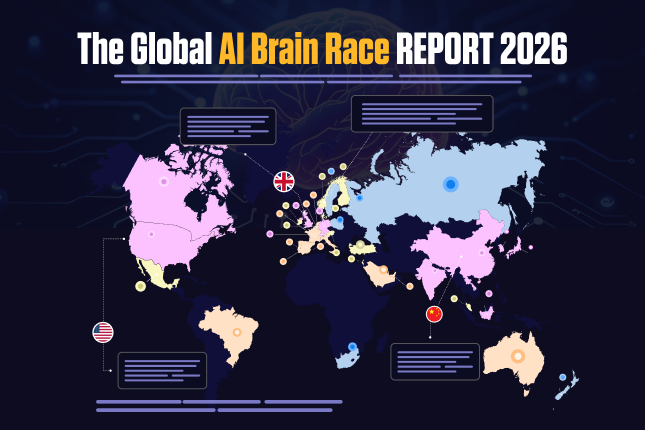
Map: Top 30+ Countries Shaping The Next Generation of AI Leaders
Below is the complete ranking of 30+ countries in the Global AI Brain Race 2026.
Each position reflects the overall AI leadership strength of a nation relative to other nations in the study. Higher-ranked countries demonstrate stronger structural readiness to compete in the global AI landscape, while lower-ranked nations are still developing critical components of their AI ecosystems.
This visualization gives you a clear global snapshot of where leadership is concentrated, where gaps are emerging, and how countries compare at a glance.

AI leadership is concentrated among a small group of nations, with a noticeable separation between the top tier and the rest. The highest-ranked countries stand out not just for individual strengths, but for overall competitiveness across multiple dimensions of AI development.
At the same time, many countries show promise but remain structurally behind the leaders. The gap between the top performers and the middle tier highlights how uneven the global AI race has become.
Next, we take a closer look at the Top 10 countries to understand what distinguishes them in this year’s rankings.
Deep Dive: Top 10 Countries Shaping The Next Generation of AI Leaders
1) United States
Rank: #1 | Final Score: 82
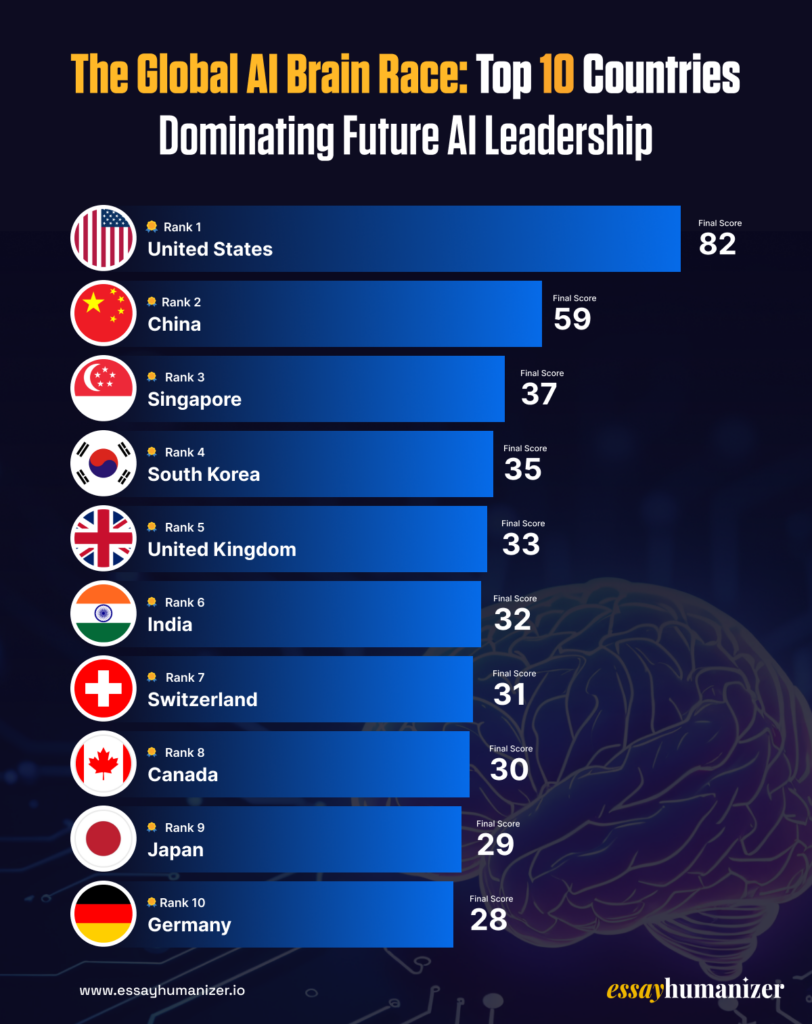
The United States ranks number 1 with a final score of 82 out of 100, making it the most structurally prepared country in the Global AI Brain Race. This score reflects overall dominance across both national AI readiness and academic strength. In simple terms, the U.S. is not leading because of one advantage. It leads because its research, economy, infrastructure, governance, talent, and universities are aligned at scale.
AI Readiness
The United States shows the strongest AI environment in the study.
It records 19.15 out of 27.78 in AI R&D, the highest research strength among all countries. It also achieves the maximum 22.22 out of 22.22 in the Economy Index, showing deep integration of AI into economic activity.
Infrastructure is another major advantage, with 16.21 out of 16.67, indicating strong compute and deployment capacity. On governance and institutional maturity, the U.S. scores 4.22 out of 5.56 in Policy and Governance and a full 5.56 out of 5.56 in Responsible AI, demonstrating stronger regulatory alignment and responsible AI engagement than most competitors.
These scores confirm that the U.S. has the most complete AI readiness framework in the ranking.
AI Education and Academic Depth
Education further strengthens this position.
The United States has 26 top universities offering AI subjects, creating broad institutional depth. It records an average AI subject score of 55.85 out of 100 and a strong average global university score of 77.42 out of 100, reflecting globally competitive academic quality.
This ensures a continuous pipeline of AI leaders emerging from high-performing institutions within a mature national ecosystem.
Key Highlight: The United States is the only country that leads simultaneously in AI R&D, economic integration, infrastructure, and responsible AI, making it the most balanced and dominant AI ecosystem in the study.
2) China
Rank: #2 | Final Score: 59
China ranks second with a final score of 59 out of 100, making it the largest-scale AI ecosystem in the study. Its position reflects massive research output, expanding infrastructure, and the deepest academic AI pipeline globally. However, institutional balance remains weaker compared to the top-ranked country.
AI Readiness
China records 17.22 out of 27.78 in the R&D Index (AI), the second-highest score in the ranking, confirming its global research strength. Its Infrastructure Index score of 6.40 out of 16.67 supports rapid deployment of AI technologies across industry and state systems.
However, institutional indicators are significantly lower. China scores 2.23 out of 5.56 in the Responsible AI Index and 0.25 out of 5.56 in the Policy and Governance Index, which reduces regulatory balance and long-term systemic stability compared to the United States.
AI Education and Academic Depth
China’s most dominant advantage is scale in education.
China has 107 universities in the Total Number of Top Universities for the AI Subjects, compared to 26 in the United States. This means China has more than 4 times the AI university base of the top-ranked country.
In quality terms, China achieves an Average Subject Score of 54.52 out of 100 and an Average Global Score of 54.06 out of 100, indicating solid academic performance driven primarily by institutional volume rather than concentrated elite quality.
Key Highlight: China has 107 top AI universities, more than 4x the U.S. total, but weaker governance (0.25 out of 5.56) limits its overall dominance.
3) Singapore
Rank: #3 | Final Score: 37
Singapore ranks third with a final score of 37 out of 100, proving that scale is not the only path to future AI dominance. Despite its small size, Singapore performs strongly because of efficiency, institutional alignment, and exceptional academic quality.
AI Readiness
Singapore shows a strong workforce and governance alignment relative to its size.
It records 9.31 out of 16.67 in the Talent Index, one of the highest talent readiness scores in the ranking. This reflects strong AI skill penetration and hiring momentum.
Its Infrastructure Index score of 2.53 out of 16.67 is modest compared to larger economies, but within a compact national system, it remains deployment-ready. Singapore also scores 0.56 out of 5.56 in the Policy and Governance Index and 0.32 out of 5.56 in the Responsible AI Index, showing structured but measured institutional development.
AI Education and Academic Depth
Singapore’s biggest advantage lies in academic quality, not volume.
Singapore has 2 universities in the total number of top universities for AI subjects, a small institutional base compared to larger countries.
However, it achieves the highest Average Subject Score in the study at 90.50 out of 100, along with a strong Average Global Score of 82.00 out of 100.
This shows a highly concentrated, elite AI education system producing top-tier global scores despite limited institutional scale.
Key Highlight: Singapore has only 2 top AI universities, but the highest average subject score in the study (90.50 out of 100), demonstrating quality over scale.
4) South Korea
Rank: #4 | Final Score: 35
South Korea ranks fourth with a final score of 35 out of 100, reflecting a strong applied AI environment supported by infrastructure strength, public acceptance, and a competitive academic base. Its position shows a country focused on execution and deployment rather than sheer scale.
AI Readiness
South Korea records 4.96 out of 16.67 in the Talent Index, reflecting a solid and growing AI workforce. Its Infrastructure Index score of 4.23 out of 16.67 is one of the strongest infrastructure performances in the top ten, supporting real-world AI deployment.
Public adoption is also notable, with 3.59 out of 5.56 in the Public Opinion Index, one of the highest societal readiness scores among leading countries.
On governance, South Korea records 1.80 out of 5.56 in the Policy and Governance Index and 0.12 out of 5.56 in the Responsible AI Index, indicating institutional development is progressing but not yet fully mature.
AI Education and Academic Depth
South Korea has 8 universities in the total number of top universities for the AI Subject, providing a meaningful academic foundation.
It achieves an average subject score of 69.82 out of 100 and an average global score of 74.22 out of 100, reflecting strong academic competitiveness and global standing.
This combination of infrastructure readiness and steady academic performance supports sustained AI growth.
Key Highlight: South Korea combines strong infrastructure (4.23 out of 16.67) and high public readiness (3.59 out of 5.56) with 8 top AI universities, positioning it as a deployment-focused AI leader.
5) United Kingdom
Rank: #5 | Final Score: 33
The United Kingdom ranks fifth with a final score of 33 out of 100, reflecting a balanced and institutionally aligned AI ecosystem. While it performs steadily across governance, research, and education, it operates at a significantly smaller scale compared to the two global AI superpowers.
AI Readiness
The UK records 5.48 out of 16.67 in the Talent Index, indicating a competitive AI workforce.
It scores 2.63 out of 16.67 in the Infrastructure Index, showing moderate deployment capacity. In governance, it performs relatively strongly with 2.53 out of 5.56 in the Policy and Governance Index, one of the better governance scores in the top ten. It also records 0.56 out of 5.56 in the Responsible AI Index, reflecting early responsible AI engagement.
Overall, the UK demonstrates balance rather than dominance across readiness indicators.
AI Education and Academic Depth
The United Kingdom has 15 universities in the total number of top universities for AI Subject, giving it one of the strongest academic presences in the top five.
It achieves an average subject score of 55.00 out of 100 and an average global score of 71.17 out of 100, reflecting strong international academic standing.
Key Highlight: Despite ranking #5, the UK’s final score of 33 is less than half of the U.S. (82) and far behind China (59), underscoring the scale gap between the UK and the two global AI leaders
6) India
Rank: #6 | Final Score: 32
India ranks sixth with a final score of 32 out of 100, driven primarily by its strong and expanding AI talent base. While it demonstrates significant workforce strength and research momentum, gaps in infrastructure and governance limit its ability to compete at the scale of the top-ranked countries.
AI Readiness
India records 9.12 out of 16.67 in the Talent Index, one of the highest talent scores in the ranking. This reflects strong AI skill penetration and workforce growth.
However, infrastructure remains a constraint, with just 0.65 out of 16.67 in the Infrastructure Index, indicating limited large-scale deployment capacity. Governance indicators are also low, with 0.11 out of 5.56 in the Policy and Governance Index and 0.35 out of 5.56 in the Responsible AI Index, showing institutional frameworks are still developing.
This creates a gap between human capital strength and national AI readiness.
AI Education and Academic Depth
India has 6 universities in the total number of top universities for the AI subject, showing a growing but still limited academic AI base relative to the leading countries.
It achieves an Average Subject Score of 39.52 out of 100 and an Average Global Score of 40.45 out of 100, reflecting a maturing AI education ecosystem that is still scaling in quality and global competitiveness.
Key Highlight: India’s strong talent score (9.12 out of 16.67) drives its ranking, but weak infrastructure (0.65 out of 16.67) and governance (0.11 out of 5.56) limit its ability to match the top five.
7) Switzerland
Rank: #7 | Final Score: 31
Switzerland ranks seventh with a final score of 31 out of 100, reflecting strong research quality and academic efficiency despite operating at a smaller national scale. Its position shows that concentrated excellence can compete with larger AI economies.
AI Readiness
Switzerland records 7.63 out of 16.67 in the Talent Index, indicating a strong and specialized AI workforce relative to its size. It also achieves 4.19 out of 16.67 in the Infrastructure Index, supporting steady research-to-application translation.
Its governance and responsible AI scores remain modest, with 0.23 out of 5.56 in the Policy and Governance Index and 0.23 out of 5.56 in the Responsible AI Index, suggesting that institutional expansion has room to grow.
Overall, Switzerland’s readiness profile reflects quality and stability rather than scale-driven expansion.
AI Education and Academic Depth
Switzerland has 2 universities in the Total Number of Top Universities for the AI Subject, a small but highly competitive academic base.
However, it achieves an Average Subject Score of 65.25 out of 100 and an impressive Average Global Score of 75.40 out of 100, placing its universities among the strongest academically in the ranking.
This highlights a highly concentrated, research-intensive education ecosystem.
It achieves an Average Subject Score of 39.52 out of 100 and an Average Global Score of 40.45 out of 100, reflecting a maturing AI education ecosystem that is still scaling in quality and global competitiveness.
Key Highlight: With just 2 top AI universities, Switzerland achieves a high Average Global Score (75.40 out of 100), demonstrating academic quality over volume.
8) Canada
Rank: #8 | Final Score: 30
Canada ranks eighth with a final score of 30 out of 100, reflecting a strong research-driven AI ecosystem supported by academic credibility and workforce stability. While it does not operate at the scale of the top-ranked countries, it maintains consistent performance across key indicators.
AI Readiness
Canada records 7.94 out of 16.67 in the Talent Index, highlighting a competitive AI workforce. It also achieves 3.19 out of 16.67 in the Infrastructure Index, supporting steady AI deployment capacity.
In governance, Canada records 0.35 out of 5.56 in the Policy and Governance Index and 0.46 out of 5.56 in the Responsible AI Index, indicating cautious but structured institutional development.
Overall, Canada demonstrates stability and research alignment rather than rapid expansion.
AI Education and Academic Depth
Canada has 6 universities in the total number of top universities for the AI subject, providing steady institutional depth.
It achieves an average subject score of 52.90 out of 100 and an average global score of 67.07 out of 100, reflecting internationally recognized academic quality.
Key Highlight: Canada combines a strong Talent Index score (7.94 out of 16.67) with 6 top AI universities, reinforcing its research-driven AI foundation.
9) Japan
Rank: #9 | Final Score: 29
Japan ranks ninth with a final score of 29 out of 100, reflecting strong infrastructure and applied AI capability, particularly in industrial and robotics-driven sectors. While its academic scale in AI is limited, its deployment capacity remains one of the strongest in the top ten.
AI Readiness
Japan records 5.70 out of 16.67 in the Talent Index, indicating steady workforce strength.
Its biggest advantage is infrastructure, with 5.51 out of 16.67 in the Infrastructure Index, one of the highest infrastructure scores among the top-ranked countries. This supports real-world AI deployment across manufacturing and advanced automation.
However, governance indicators remain modest, with 0.21 out of 5.56 in the Policy and Governance Index and 0.30 out of 5.56 in the Responsible AI Index, suggesting limited institutional expansion in AI regulation and responsible AI research.
AI Education and Academic Depth
Japan has 1 university in the total number of top universities for AI subjects, indicating a limited AI-specific academic scale.
It achieves an Average Subject Score of 46.10 out of 100 and a strong Average Global Score of 72.20 out of 100, reflecting solid global academic standing despite low AI program concentration.
Key Highlight: Japan stands out in infrastructure (5.51 out of 16.67) but has only 1 top AI university, showing strength in deployment rather than academic scale.
10) Germany
Rank: #10 | Final Score: 28
Germany ranks 10th with a final score of 28 out of 100, making it the only European Union country in the top ten. Its position reflects strong engineering foundations and applied AI capability, particularly across industrial and manufacturing systems. However, its overall scale remains significantly smaller than the top-ranked global leaders.
AI Readiness
Germany records 5.76 out of 16.67 in the Talent Index, showing steady workforce readiness. It achieves 3.00 out of 16.67 in the Infrastructure Index, indicating reliable but not dominant deployment capacity.
On governance, Germany scores 0.52 out of 5.56 in the Policy and Governance Index and 0.66 out of 5.56 in the Responsible AI Index, reflecting gradual institutional development in AI regulation and responsible AI engagement.
Overall, Germany demonstrates structural stability but lacks the scale of higher-ranked countries.
AI Education and Academic Depth
Germany has 1 university in the total number of top universities for the AI subject, indicating limited AI-specific academic volume compared to other top ten countries.
However, it achieves a strong Average Subject Score of 65.90 out of 100 and an Average Global Score of 72.50 out of 100, showing solid academic quality despite limited institutional scale.
Germany’s AI competitiveness is driven more by applied engineering strength than by broad academic expansion.
Key Highlight: Germany is the only EU country in the top 10 (Final Score: 28 out of 100), supported by strong academic quality (Average Subject Score: 65.90 out of 100) but limited institutional scale (1 top AI university).
Conclusion
The Global AI Brain Race shows that future AI dominance in AI leadership is not driven by a single factor, such as research output, talent size, or university count. Instead, countries that rank highest are those that successfully align education, talent, infrastructure, policy, and real-world adoption into a cohesive national system.
The United States leads because it performs strongly across every major dimension, combining research scale, economic integration, infrastructure readiness, governance, and academic depth. China follows through with unmatched scale and execution, but a weaker institutional balance limits its ability to overtake the top position. Singapore demonstrates that efficiency and academic quality can rival scale, while countries like South Korea, the United Kingdom, and Canada show the importance of stability and applied AI readiness.
At the same time, the rankings highlight a clear divide between countries positioned for long-term AI leadership and those with emerging capability. High talent availability or strong research alone is not enough without supporting infrastructure, governance, and education systems that can sustain progress over time.
Overall, the data makes one conclusion clear. Countries best positioned for future AI dominance are those that invest not only in technology but also in the people, institutions, and environments required to develop the next generation of AI leaders consistently.
Methodology of Our Study
How We Ranked Countries Shaping the Next Generation of AI Leaders
The objective of this study was to develop a transparent, data-driven ranking of countries positioned for sustained AI leadership.
To achieve this, we built a blended composite scoring framework evaluating two foundational pillars:
- National AI Ecosystem Strength & Readiness
- Academic Leadership Capacity & Depth of AI Education
The first pillar measures how structurally prepared a country is to compete in artificial intelligence today. It captures national research intensity, economic AI integration, infrastructure capacity, governance maturity, public engagement, and responsible AI development.
The second pillar evaluates long-term AI leadership potential by assessing the strength, depth, and global competitiveness of AI-focused higher education institutions.
All indicators were normalized and weighted to generate a final composite score out of 100 for each country.
Scoring Framework:
Maximum Point Allocation
Each country was evaluated using a structured composite model with a maximum attainable score of 100 points, distributed across seven core ecosystem indicators:
| Indicator | Maximum Points |
| AI Research & Development (R&D) Index | 27.78 |
| AI Economy Index | 22.22 |
| AI Talent Index | 16.67 |
| AI Infrastructure Index | 16.67 |
| Responsible AI Index | 5.56 |
| Policy & Governance Index | 5.56 |
| Public Opinion Index | 5.56 |
| Total Maximum Score | 100 |
A country’s final score reflects its cumulative performance relative to this 100-point benchmark.
Weighting Structure:
The final score combines ecosystem and academic indicators using the following weighting model:
National AI Ecosystem Strength & Readiness (65%)
| Indicator | Weight |
| R&D Index (AI) | 15% |
| Economy Index | 15% |
| Infrastructure Index | 10% |
| Talent Index | 10% |
| Responsible AI Index | 5% |
| Policy & Governance Index | 5% |
| Public Opinion Index | 5% |
These indicators measure the vibrancy and structural maturity of a country’s AI environment.
Academic Leadership Capacity & Depth of AI Education (35%)
| Indicator | Weight |
| Total Number of Top Universities for AI Subjects | 15% |
| Average AI Subject Score (out of 100) | 10% |
| Average Global University Score (out of 100) | 10% |
These indicators evaluate institutional depth, academic quality, and the ability to produce future AI leaders.
Data Sources:
- Stanford AI Index Report: National AI activity, research, economic integration, infrastructure, governance, public sentiment, and responsible AI indicators.
- U.S. News Education Rankings: AI subject rankings and university counts.
- Global University Ranking Systems: Overall academic quality and global institutional standing.
Final Scoring Process:
Each indicator was normalized to ensure cross-country comparability.
Normalized values were multiplied by assigned weights and aggregated to produce a Final Composite Score (0–100).
All rankings are strictly data-based and reflect measurable structural readiness for sustained AI leadership.
Why This Blended Model Matters:
This methodology prevents bias toward scale or education alone.
Countries with strong AI activity but weak academic depth are not overrated.
Countries with strong universities but limited ecosystem maturity are not overranked.
The highest-ranked nations are those where research, economy, infrastructure, governance, public readiness, and education reinforce one another.
The result is a ranking that identifies not only today’s AI leaders but also the countries best positioned to sustain and dominate AI leadership in the years ahead.


Vitaly Gariev
Get updates in your inbox
.Subscribe to our emails to receive newsletters, product updates, and marketing communications.
Recent Articles